
From Cut Panels to Assembled Hoodies
Hoodie sewing begins after fabric panels have been cut, identified and bundled by style, color and size. The sewing team uses the approved sample, confirmed construction details and measurement specifications as production references.
This stage directly affects garment shape, seam strength, comfort and finished appearance. Poor component alignment can result in twisted sleeves, uneven hems, distorted pockets or differences between the approved sample and bulk order.
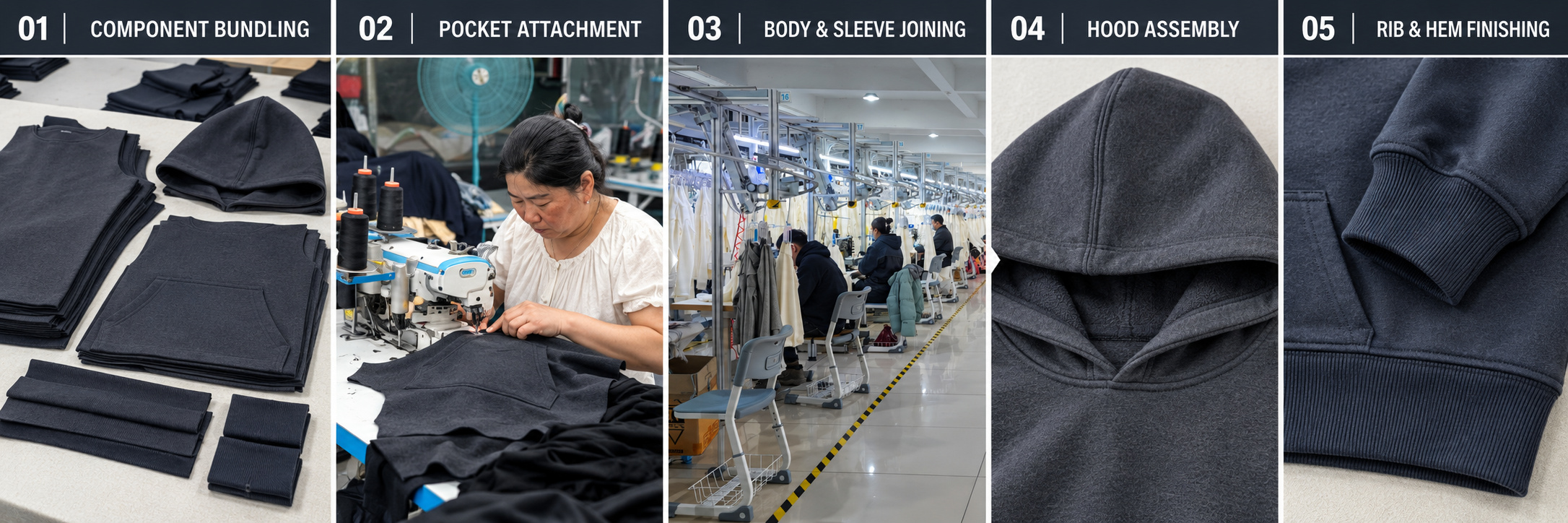
Before sewing starts, bundles from the Fabric Spreading & Cutting stage are checked to confirm that the required body panels, sleeves, hood pieces, pockets and rib components are complete.
 Sewing Methods Based on Garment Construction
Different hoodie components require different sewing methods. Lockstitch, overlock, coverstitch, flatlock and bar-tack equipment may be used according to the approved garment construction and workmanship requirements.
Overlock stitching is commonly used to join knit fabric panels and control raw edges. Coverstitch may be used for selected hems or visible seam details, while bar-tacks can reinforce stress points such as pocket openings and drawcord areas when required by the specification.
The stitch type, seam allowance, thread and stitch density should match the approved sample. These details can change according to fabric weight, stretch, hoodie structure and the intended appearance.
Body, Sleeve and Hood Assembly
The main assembly sequence normally includes joining the shoulder seams, attaching sleeves, closing the side and sleeve seams, and adding cuffs and bottom rib. The exact order may change for oversized, panelled, zip-up or specially constructed hoodies.
Hood assembly requires attention to symmetry, seam matching and the position of drawcord openings or eyelets. For lined or double-layer hoods, the inner and outer sections must align correctly without excessive twisting or bulk at the neckline.
Pocket placement is also checked before attachment. A kangaroo pocket should remain level and centered, while separate zip-up pockets must align across the front opening.
Zippers, Ribs and Branded Components
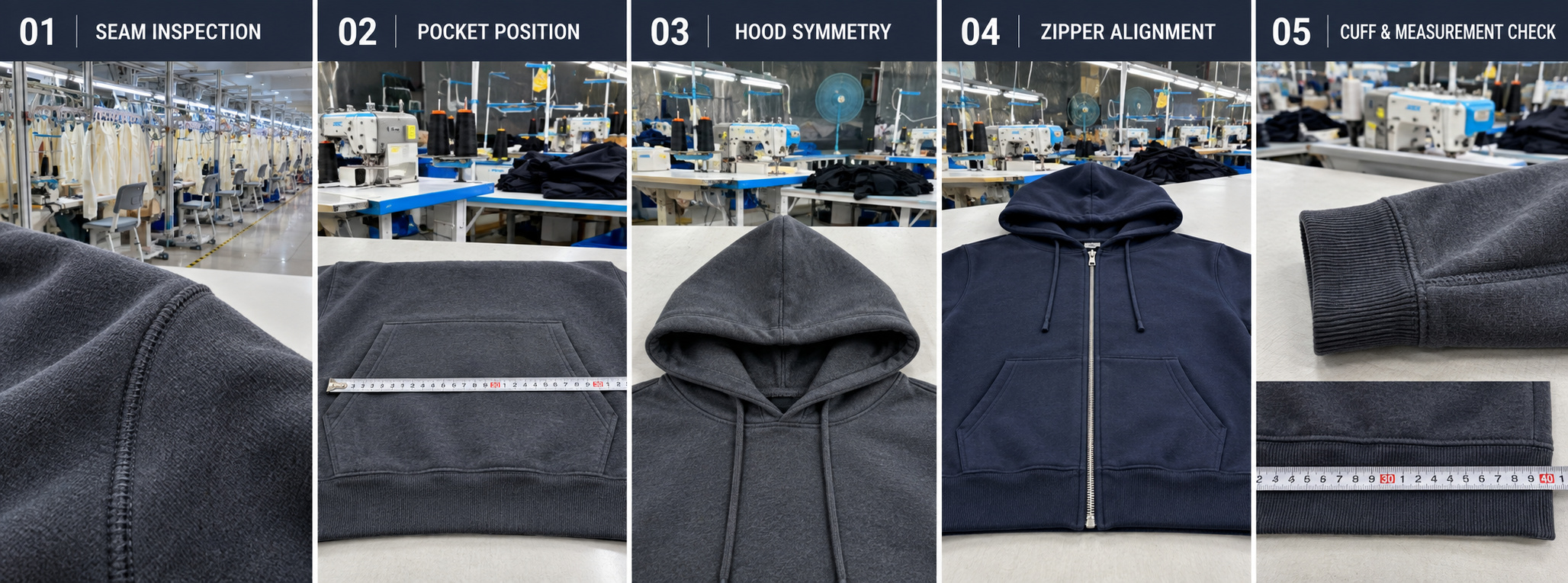
Zip-up hoodies require control of zipper length, front-edge alignment and matching hem positions. If the two sides are not handled consistently during sewing, the front can appear uneven when the zipper is closed.
Cuffs and bottom rib must be matched to the main fabric and attached with controlled tension. Excessive tension can cause puckering, while insufficient recovery may result in loose cuffs or a wavy hem.
Neck labels, size labels and care labels are attached at the confirmed positions. Printed, embroidered or patched panels completed through the Printing & Embroidery stage must also be protected from incorrect orientation or placement during assembly.
In-Process Sewing Checks
Checks during sewing focus on component alignment, seam appearance, skipped stitches, loose threads, puckering and visible damage. Key areas include the hood neckline, shoulders, armholes, pocket openings, zipper ends, cuffs and bottom hem.
The production team also compares selected garments with the approved sample and confirmed measurements. Early correction is important because repeated sewing errors become more difficult to control after a large quantity has been assembled.
 Preparing Garments for Finishing
After assembly, garments move to Finishing & Measurement Inspection for thread trimming, appearance review, measurement checks and packing preparation. Issues found at this stage are recorded for repair or separation before final inspection.
For an accurate hoodie production review, buyers should provide the style, fabric and GSM, size chart, construction details, artwork, label positions and any special workmanship requirements. The approved sample should define the expected sewing standard before bulk production begins.